


Spielberg on Heavy Metal’s “1941” Comic: “Nothing Wrong With Beastiality, Cannibalism”
Spielberg on Heavy Metal’s “1941” Comic: “Nothing Wrong With Beastiality, Cannibalism”
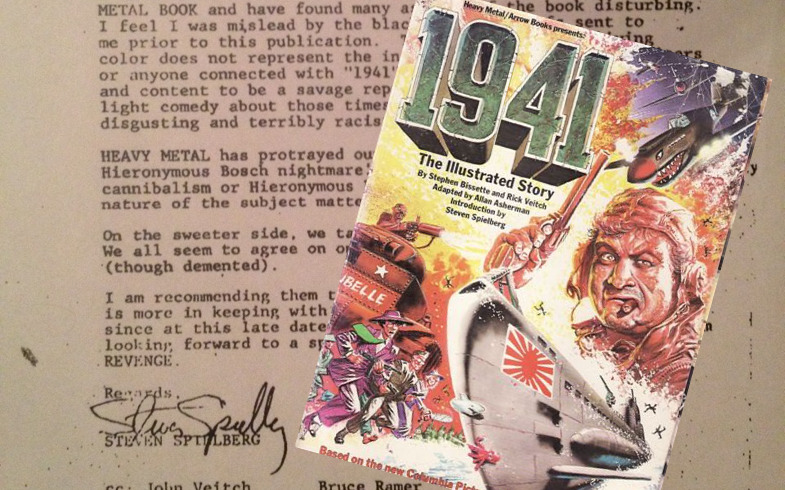
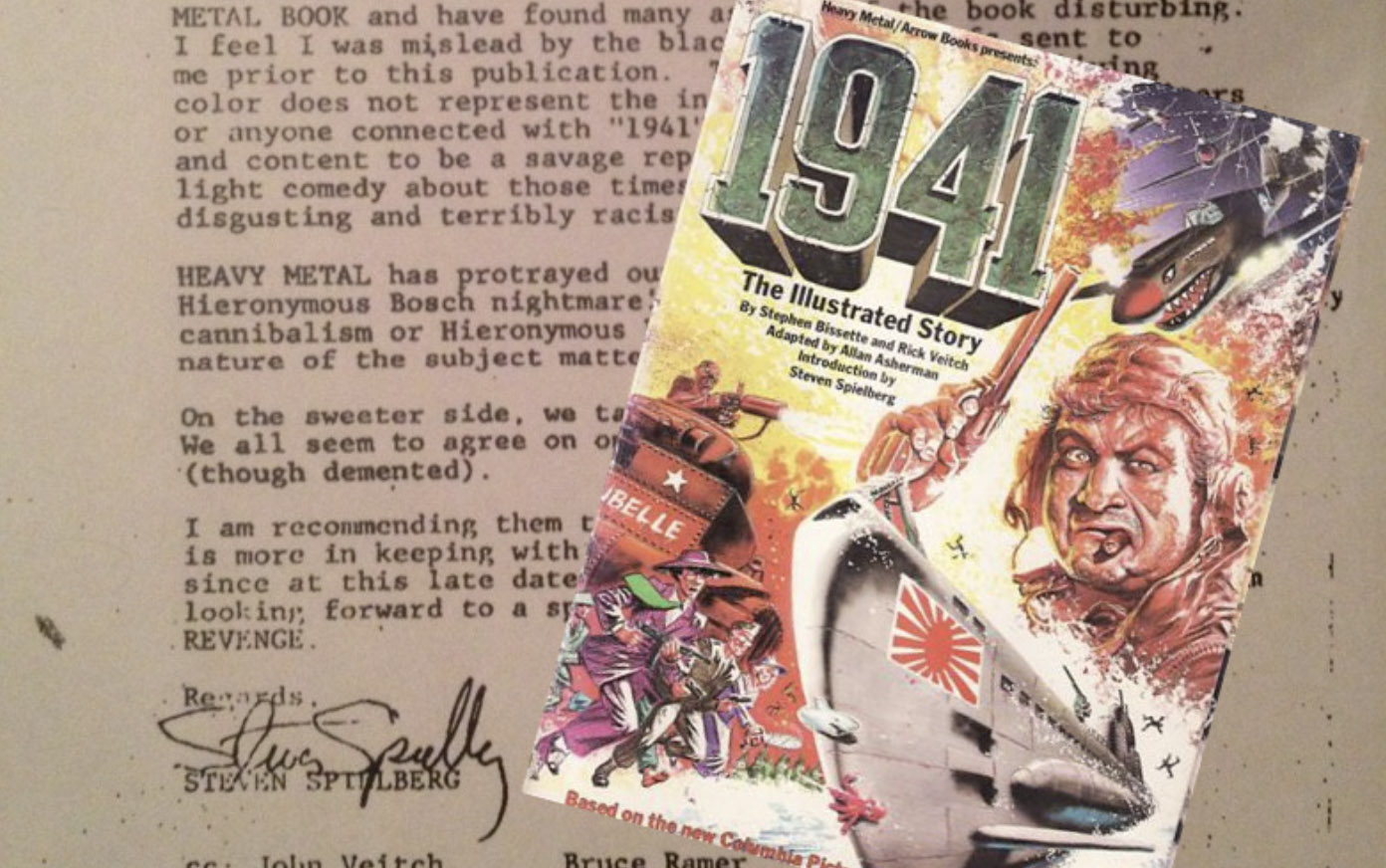
The Tumblr blog Panel to Panel has dug up an amazing artifact of comics/movie/Heavy Metal history. It’s a letter from Steven Spielberg to Heavy Metal editor Julie Simmons regarding 1941: The Illustrated Story (available for $6.00 in the Heavy Metal store), a comic-book adaptation of the Spielberg-directed 1979 comedy 1941.
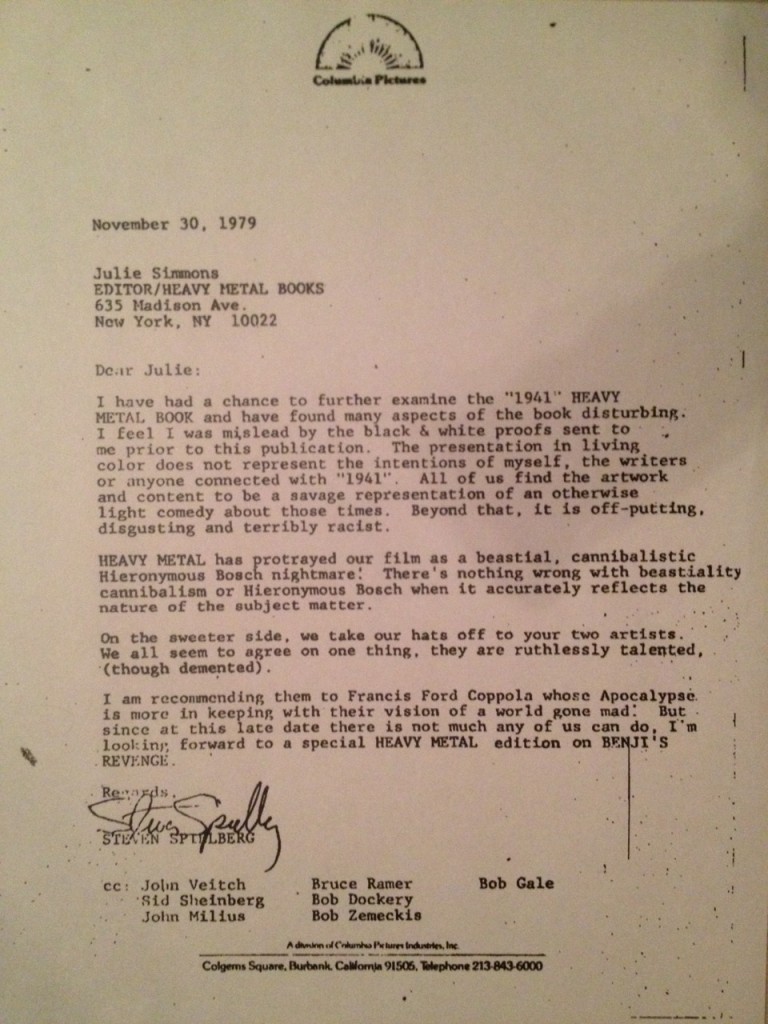
Spielberg says he’s not happy with the adaptation, feeling that it
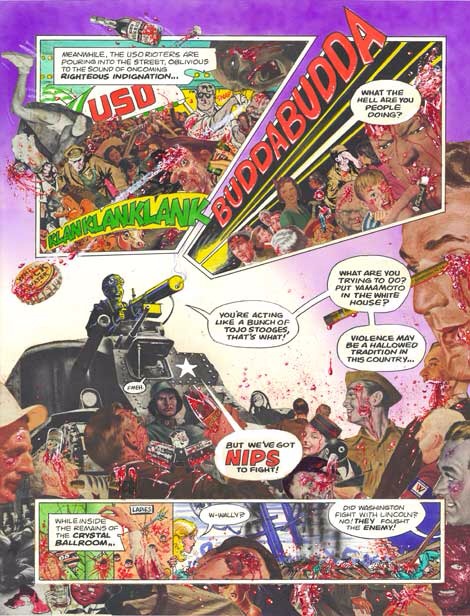
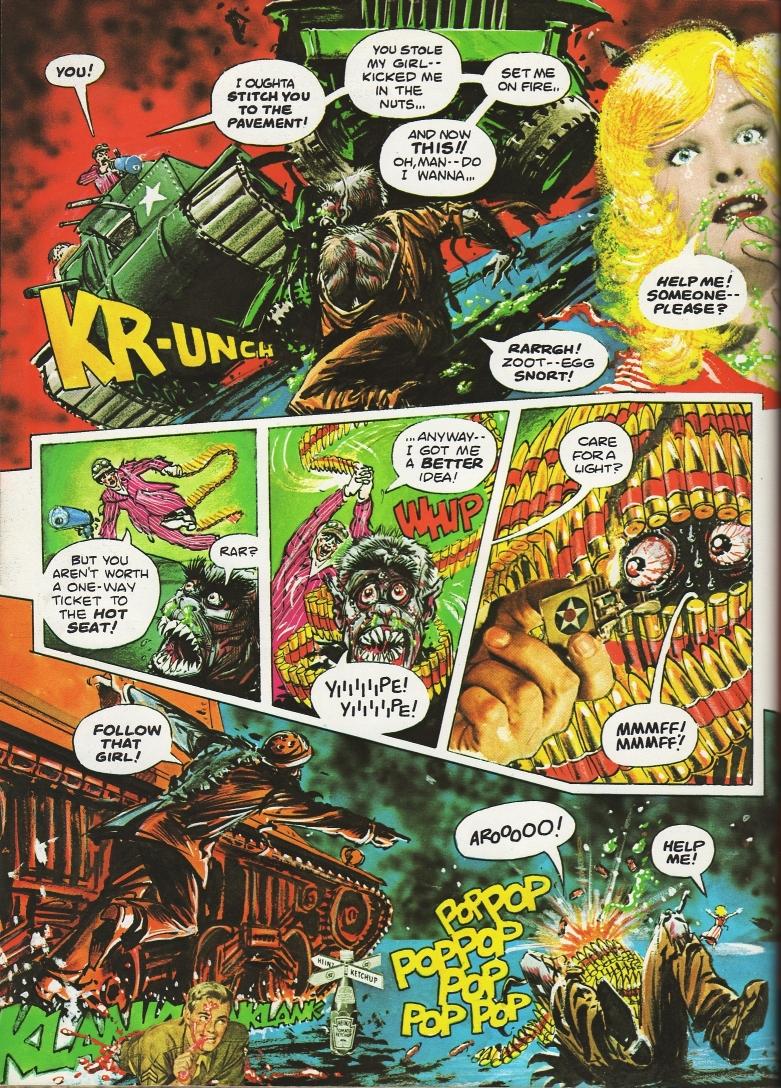
does not represent the intentions of myself, the writers or anyone connected with ‘1941.’ All of us find the artwork and content to be a savage representation of an otherwise light vomedy about those times. Beyond that, it is off-putting, disgusting and terribly racist.
Spielberg keeps going, in words he might not have used had he known this letter would turn up 35 years later:
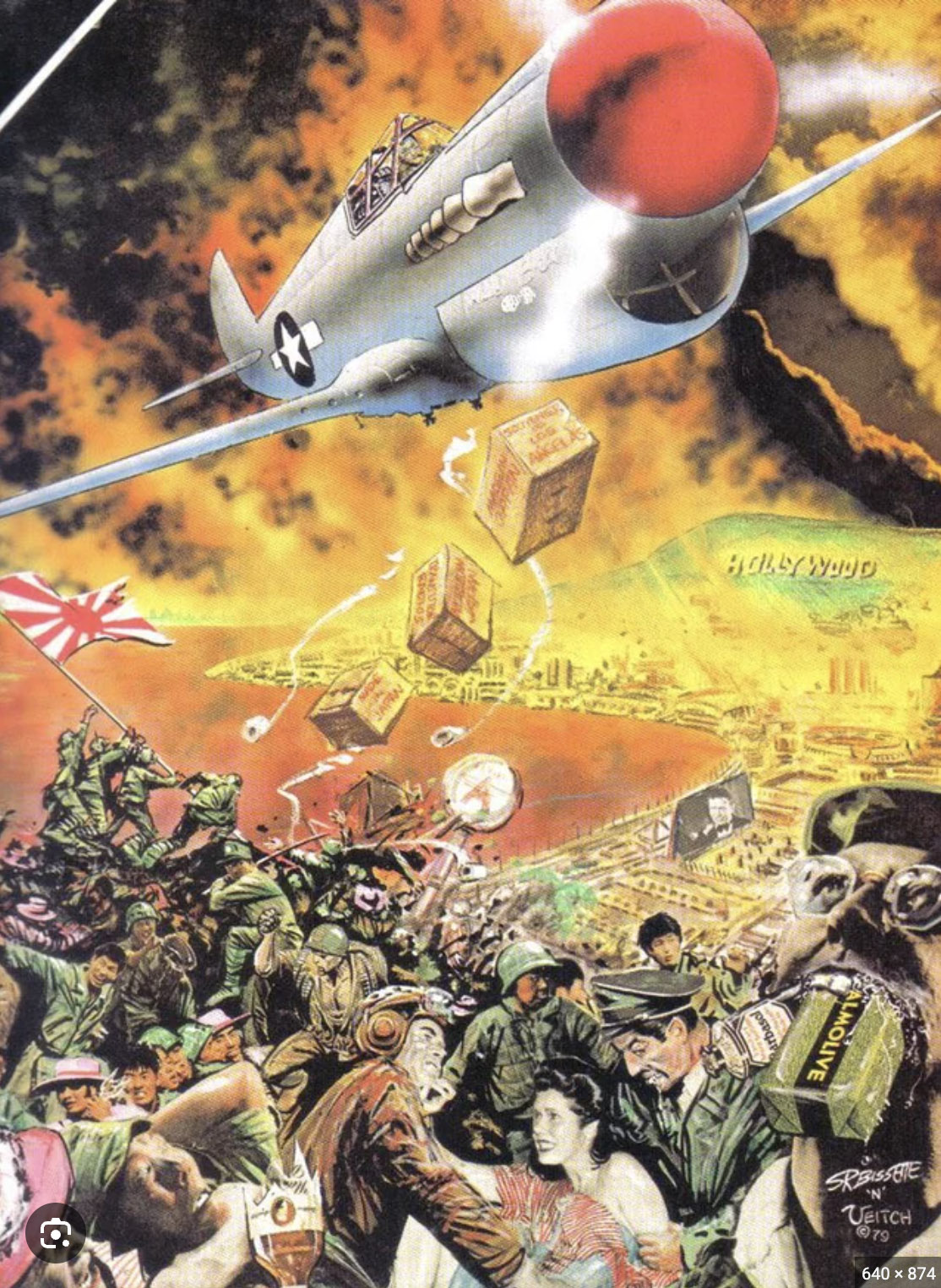
HEAVY METAL has protrayed (sic) our film as a beastial (sic), cannibalistic, Hieronymus Bosch nightmare. There’s nothing wrong with beastiality (sic) cannibalism or Hieronymous Bosch when it accurately reflects the nature of the subject matter.
Despite the complaints, Spielberg finishes up his letter with a friendly tone, shrugging that “at this late date there is not much any of us can do.” He also praises Heavy Metal’s creative team of Stephen Bissette and Rick Veitch as “ruthlessly talented (though demented).”
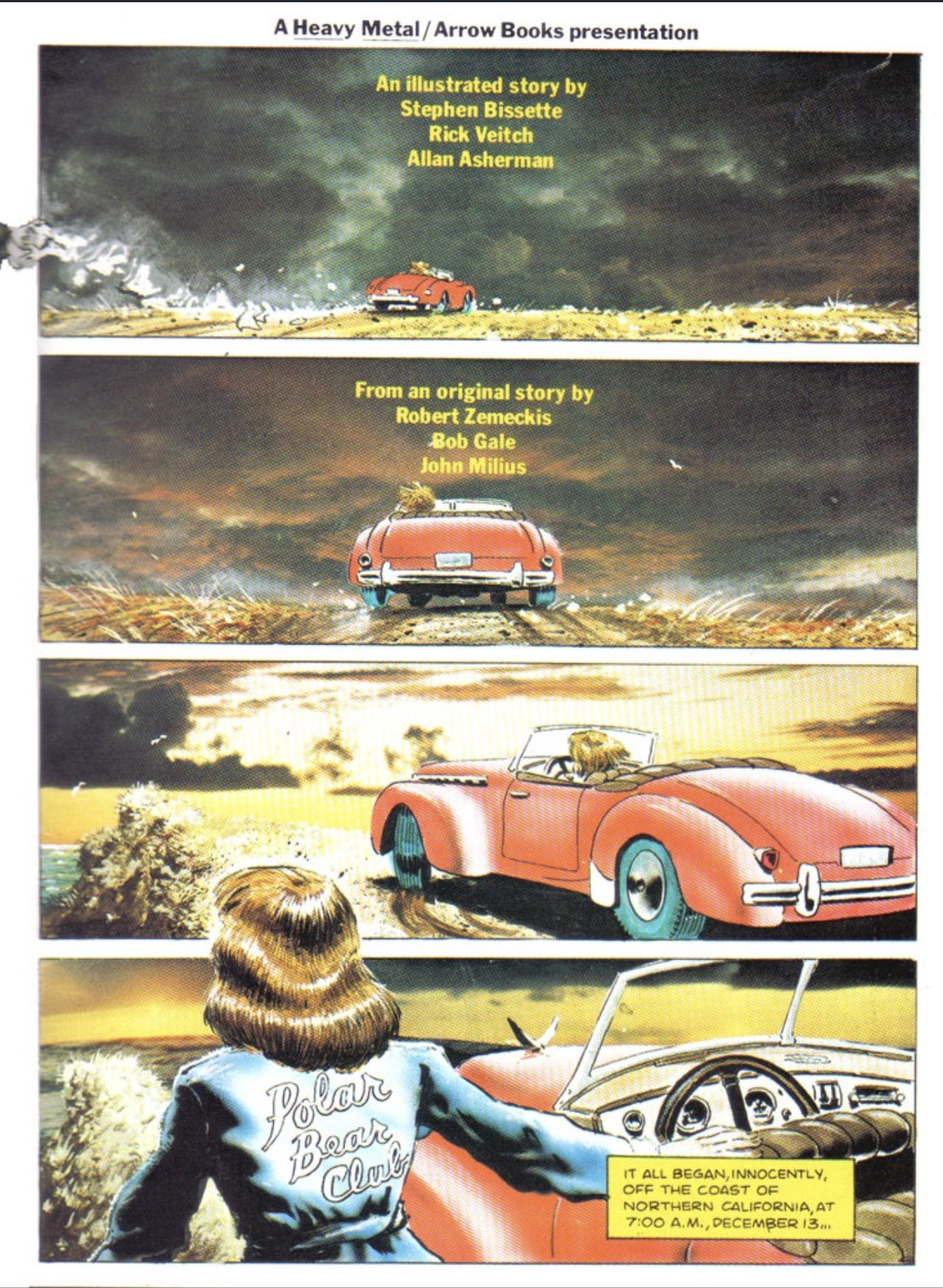
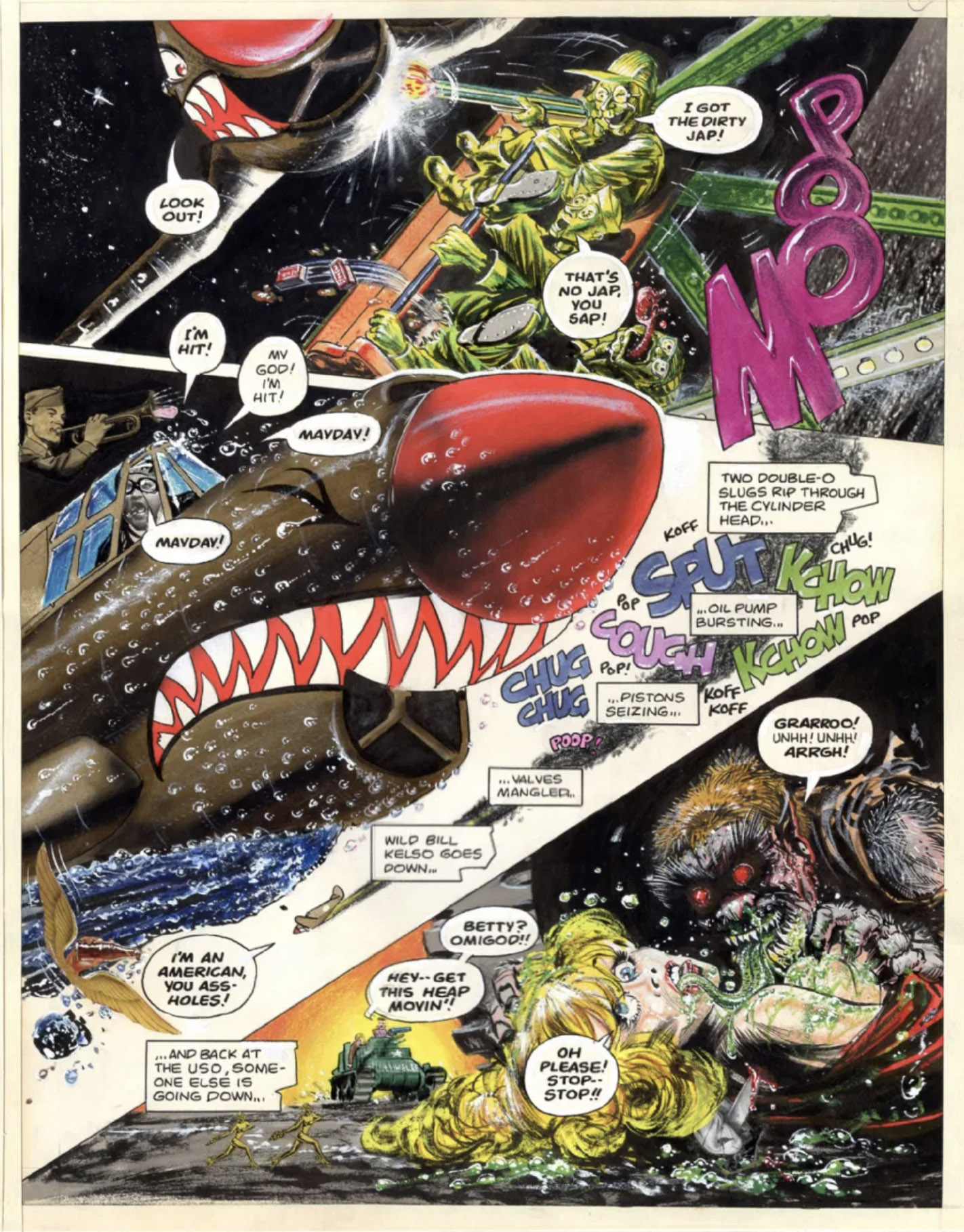
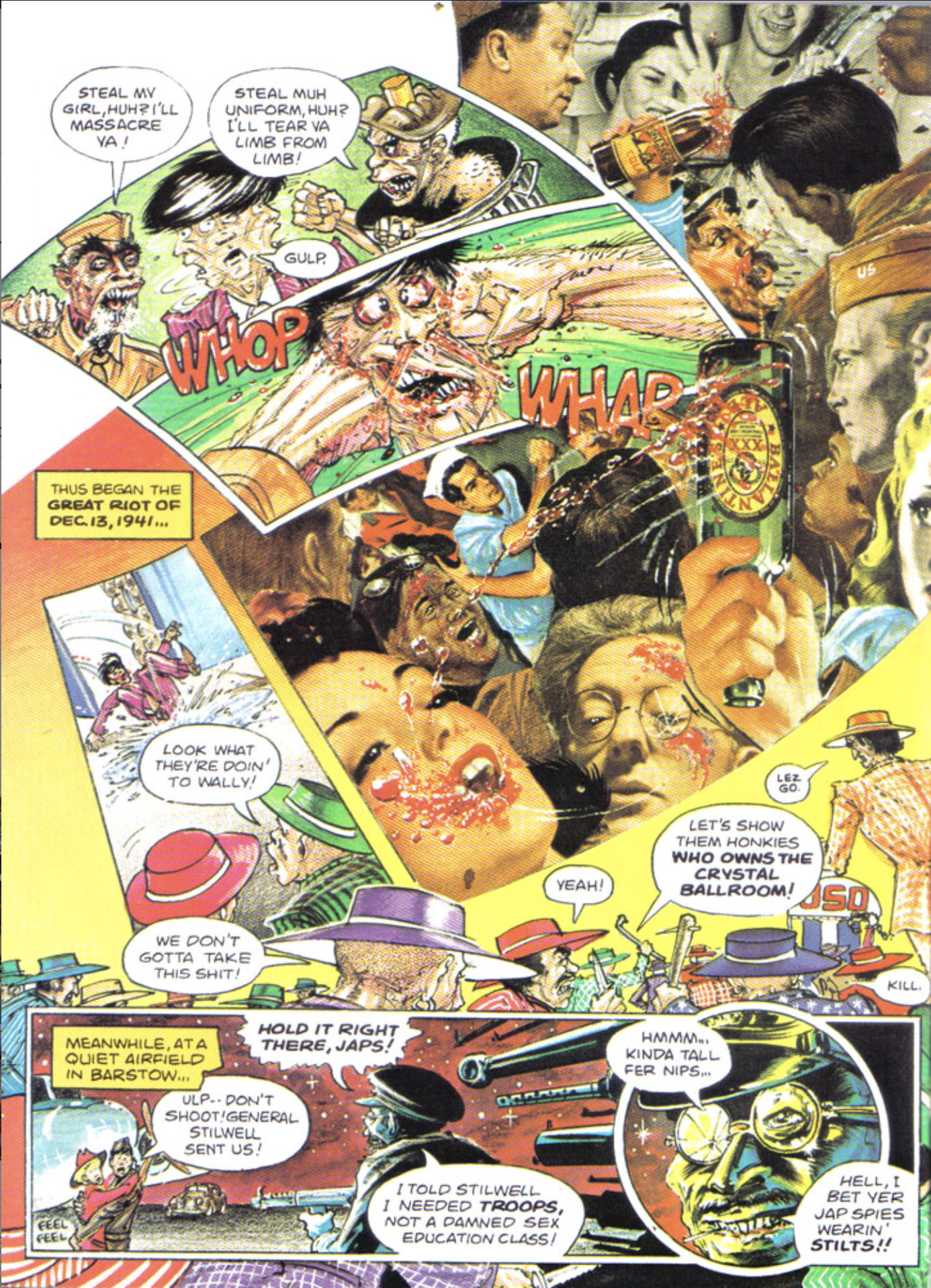
A page from Heavy Metal’s adaptation of 1941
We’re writing this some 35-ish years after the fact, and we long ago lost Steven Spielberg’s direct phone number, so this is a little speculative — but Spielberg was clearly in a weird place when he made 1941. His two previous films were Jaws and Close Encounters of the Third Kind. Those were blockbusters. Classics. And not super funny. Then Spielberg rounds up every actor in Hollywood to make a World War II comedy. John Wayne declined to be in the movie (as Major General Stillwell, played by Robert Stack) and in fact advised Spielberg not to make it at all because he felt it was unpatriotic.
Spielberg’s own introduction to 1941: The Illustrated Story is really not far off from the letter he wrote us, and finds him thumbing his nose at the killjoys.
I felt that after the war in Vietnam and the disillusionment the nation experienced, it was important to remind people that war doesn’t have to be a trip up the river to hell. It could also be a lot of laughs. I believe that 1941 stresses the positive aspects of global conflict, which is something we tend to forget about these days.
Um, what???

Spielberg says a bunch more funny things in his intro, for instance:
Columbia and Universal forced me to spend $30 million on 1941. The film’s actual cost was $12.5 million. The rest of the budget was spent on prostitutes and drugs.
True story: he said the same thing about Schindler’s List. Spielberg finishes up his introduction by saying:
I can see 1941 more as a cleansing experience. The one possible way I can make you forget all the good things I’ve done in motion pictures. Be merciful.
He wrote this three months before the movie came out. So we’d guess he wasn’t surprised when 1941 was roundly panned, with critic Pauline Kael famously saying watching it was like “having your head stuck inside a pinball machine for two hours.” 1941, the movie, has picked up a following in the intervening years, with its fans seeing the threads of genius that Kael and others couldn’t (not in the 1979 theatrical cut, at least).
But back to the subject, Heavy Metal‘s 1941: The Illustrated Story — did Spielberg really hate it, or was he just taking the piss out of everything in 1979? Who knows. We do know this nearly-forgotten comic by Allen Asherman, Stephen Bissette and Rick Veitch was genius from day one, and still is, and it can be yours for six bucks from the Heavy Metal store. Check it out.
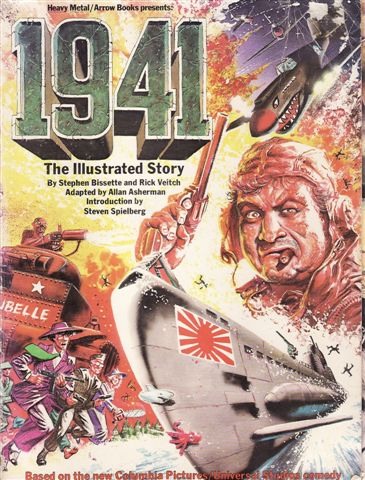
Heavy Metal’s adaptation of 1941
About Heavy Metal
First published in 1977, Heavy Metal Magazine, the world’s foremost illustrated magazine, explores fantastic and surrealistic worlds, alternate realities, science fiction and horror, in the past, present, and future. Writers and illustrators from around the world take you to places you never dreamed existed. Heavy Metal Magazine was the first publisher to bring European legends like Mœbius, Philippe Caza, Guido Crepax, Philippe Druillet, Tanino Liberatore, Milo Manara, Enki Bilal, and Pepe Moreno to the U.S. while showcasing non-mainstream American superstars like Richard Corben, Berni Wrightson, Arthur Suydam, Vaughn Bode and Frank Frazetta. The magazine continues to showcase amazing new talent along with established creators. Heavy Metal Magazine features serialized and standalone stories, artist galleries, short stories in prose and interviews.
About Heavy Metal (film)
Heavy Metal is a 1981 Canadian adult animated science fantasy anthology film directed by Gerald Potterton (in his director debut) and produced by Ivan Reitman and Leonard Mogel, who also was the publisher of Heavy Metal magazine, which was the basis for the film. It starred the voices of Rodger Bumpass, Jackie Burroughs, John Candy, Joe Flaherty, Don Francks, Martin Lavut, Marilyn Lightstone, Eugene Levy, Alice Playten, Harold Ramis, Percy Rodriguez, Susan Roman, Richard Romanus, August Schellenberg, John Vernon, and Zal Yanovsky. The screenplay was written by Daniel Goldberg and Len Blum.
The film is an anthology of various science-fiction and fantasy stories tied together by a single theme of an evil force that is "the sum of all evils". It was adapted from Heavy Metal magazine and original stories in the same spirit. Like the magazine, the film features a great deal of graphic violence, sexuality, and nudity. Its production was expedited by having several animation houses working simultaneously on different segments.
Its soundtrack was packaged by music manager Irving Azoff and included several popular rock bands and artists, including Black Sabbath, Blue Öyster Cult, Sammy Hagar, Don Felder, Cheap Trick, DEVO, Journey, and Nazareth, among others.


The Definitive brand in fantasy, science fiction, and horror.
Announcements

Browse by tag
Spielberg on Heavy Metal’s “1941” Comic: “Nothing Wrong With Beastiality, Cannibalism”
Spielberg on Heavy Metal’s “1941” Comic: “Nothing Wrong With Beastiality, Cannibalism”
The Tumblr blog Panel to Panel has dug up an amazing artifact of comics/movie/Heavy Metal history. It’s a letter from Steven Spielberg to Heavy Metal editor Julie Simmons regarding 1941: The Illustrated Story (available for $6.00 in the Heavy Metal store), a comic-book adaptation of the Spielberg-directed 1979 comedy 1941.
Spielberg says he’s not happy with the adaptation, feeling that it
does not represent the intentions of myself, the writers or anyone connected with ‘1941.’ All of us find the artwork and content to be a savage representation of an otherwise light vomedy about those times. Beyond that, it is off-putting, disgusting and terribly racist.
Spielberg keeps going, in words he might not have used had he known this letter would turn up 35 years later:
HEAVY METAL has protrayed (sic) our film as a beastial (sic), cannibalistic, Hieronymus Bosch nightmare. There’s nothing wrong with beastiality (sic) cannibalism or Hieronymous Bosch when it accurately reflects the nature of the subject matter.
Despite the complaints, Spielberg finishes up his letter with a friendly tone, shrugging that “at this late date there is not much any of us can do.” He also praises Heavy Metal’s creative team of Stephen Bissette and Rick Veitch as “ruthlessly talented (though demented).”
A page from Heavy Metal’s adaptation of 1941
We’re writing this some 35-ish years after the fact, and we long ago lost Steven Spielberg’s direct phone number, so this is a little speculative — but Spielberg was clearly in a weird place when he made 1941. His two previous films were Jaws and Close Encounters of the Third Kind. Those were blockbusters. Classics. And not super funny. Then Spielberg rounds up every actor in Hollywood to make a World War II comedy. John Wayne declined to be in the movie (as Major General Stillwell, played by Robert Stack) and in fact advised Spielberg not to make it at all because he felt it was unpatriotic.
Spielberg’s own introduction to 1941: The Illustrated Story is really not far off from the letter he wrote us, and finds him thumbing his nose at the killjoys.
I felt that after the war in Vietnam and the disillusionment the nation experienced, it was important to remind people that war doesn’t have to be a trip up the river to hell. It could also be a lot of laughs. I believe that 1941 stresses the positive aspects of global conflict, which is something we tend to forget about these days.
Um, what???
Spielberg says a bunch more funny things in his intro, for instance:
Columbia and Universal forced me to spend $30 million on 1941. The film’s actual cost was $12.5 million. The rest of the budget was spent on prostitutes and drugs.
True story: he said the same thing about Schindler’s List. Spielberg finishes up his introduction by saying:
I can see 1941 more as a cleansing experience. The one possible way I can make you forget all the good things I’ve done in motion pictures. Be merciful.
He wrote this three months before the movie came out. So we’d guess he wasn’t surprised when 1941 was roundly panned, with critic Pauline Kael famously saying watching it was like “having your head stuck inside a pinball machine for two hours.” 1941, the movie, has picked up a following in the intervening years, with its fans seeing the threads of genius that Kael and others couldn’t (not in the 1979 theatrical cut, at least).
But back to the subject, Heavy Metal‘s 1941: The Illustrated Story — did Spielberg really hate it, or was he just taking the piss out of everything in 1979? Who knows. We do know this nearly-forgotten comic by Allen Asherman, Stephen Bissette and Rick Veitch was genius from day one, and still is, and it can be yours for six bucks from the Heavy Metal store. Check it out.
Heavy Metal’s adaptation of 1941
About Heavy Metal
First published in 1977, Heavy Metal Magazine, the world’s foremost illustrated magazine, explores fantastic and surrealistic worlds, alternate realities, science fiction and horror, in the past, present, and future. Writers and illustrators from around the world take you to places you never dreamed existed. Heavy Metal Magazine was the first publisher to bring European legends like Mœbius, Philippe Caza, Guido Crepax, Philippe Druillet, Tanino Liberatore, Milo Manara, Enki Bilal, and Pepe Moreno to the U.S. while showcasing non-mainstream American superstars like Richard Corben, Berni Wrightson, Arthur Suydam, Vaughn Bode and Frank Frazetta. The magazine continues to showcase amazing new talent along with established creators. Heavy Metal Magazine features serialized and standalone stories, artist galleries, short stories in prose and interviews.
About Heavy Metal (film)
Heavy Metal is a 1981 Canadian adult animated science fantasy anthology film directed by Gerald Potterton (in his director debut) and produced by Ivan Reitman and Leonard Mogel, who also was the publisher of Heavy Metal magazine, which was the basis for the film. It starred the voices of Rodger Bumpass, Jackie Burroughs, John Candy, Joe Flaherty, Don Francks, Martin Lavut, Marilyn Lightstone, Eugene Levy, Alice Playten, Harold Ramis, Percy Rodriguez, Susan Roman, Richard Romanus, August Schellenberg, John Vernon, and Zal Yanovsky. The screenplay was written by Daniel Goldberg and Len Blum.
The film is an anthology of various science-fiction and fantasy stories tied together by a single theme of an evil force that is "the sum of all evils". It was adapted from Heavy Metal magazine and original stories in the same spirit. Like the magazine, the film features a great deal of graphic violence, sexuality, and nudity. Its production was expedited by having several animation houses working simultaneously on different segments.
Its soundtrack was packaged by music manager Irving Azoff and included several popular rock bands and artists, including Black Sabbath, Blue Öyster Cult, Sammy Hagar, Don Felder, Cheap Trick, DEVO, Journey, and Nazareth, among others.
Announcements


Newsletter
Browse by tag
Spielberg on Heavy Metal’s “1941” Comic: “Nothing Wrong With Beastiality, Cannibalism”
The Tumblr blog Panel to Panel has dug up an amazing artifact of comics/movie/Heavy Metal history. It’s a letter from Steven Spielberg to Heavy Metal editor Julie Simmons regarding 1941: The Illustrated Story (available for $6.00 in the Heavy Metal store), a comic-book adaptation of the Spielberg-directed 1979 comedy 1941.
Spielberg says he’s not happy with the adaptation, feeling that it
does not represent the intentions of myself, the writers or anyone connected with ‘1941.’ All of us find the artwork and content to be a savage representation of an otherwise light vomedy about those times. Beyond that, it is off-putting, disgusting and terribly racist.
Spielberg keeps going, in words he might not have used had he known this letter would turn up 35 years later:
HEAVY METAL has protrayed (sic) our film as a beastial (sic), cannibalistic, Hieronymus Bosch nightmare. There’s nothing wrong with beastiality (sic) cannibalism or Hieronymous Bosch when it accurately reflects the nature of the subject matter.
Despite the complaints, Spielberg finishes up his letter with a friendly tone, shrugging that “at this late date there is not much any of us can do.” He also praises Heavy Metal’s creative team of Stephen Bissette and Rick Veitch as “ruthlessly talented (though demented).”
A page from Heavy Metal’s adaptation of 1941
We’re writing this some 35-ish years after the fact, and we long ago lost Steven Spielberg’s direct phone number, so this is a little speculative — but Spielberg was clearly in a weird place when he made 1941. His two previous films were Jaws and Close Encounters of the Third Kind. Those were blockbusters. Classics. And not super funny. Then Spielberg rounds up every actor in Hollywood to make a World War II comedy. John Wayne declined to be in the movie (as Major General Stillwell, played by Robert Stack) and in fact advised Spielberg not to make it at all because he felt it was unpatriotic.
Spielberg’s own introduction to 1941: The Illustrated Story is really not far off from the letter he wrote us, and finds him thumbing his nose at the killjoys.
I felt that after the war in Vietnam and the disillusionment the nation experienced, it was important to remind people that war doesn’t have to be a trip up the river to hell. It could also be a lot of laughs. I believe that 1941 stresses the positive aspects of global conflict, which is something we tend to forget about these days.
Um, what???
Spielberg says a bunch more funny things in his intro, for instance:
Columbia and Universal forced me to spend $30 million on 1941. The film’s actual cost was $12.5 million. The rest of the budget was spent on prostitutes and drugs.
True story: he said the same thing about Schindler’s List. Spielberg finishes up his introduction by saying:
I can see 1941 more as a cleansing experience. The one possible way I can make you forget all the good things I’ve done in motion pictures. Be merciful.
He wrote this three months before the movie came out. So we’d guess he wasn’t surprised when 1941 was roundly panned, with critic Pauline Kael famously saying watching it was like “having your head stuck inside a pinball machine for two hours.” 1941, the movie, has picked up a following in the intervening years, with its fans seeing the threads of genius that Kael and others couldn’t (not in the 1979 theatrical cut, at least).
But back to the subject, Heavy Metal‘s 1941: The Illustrated Story — did Spielberg really hate it, or was he just taking the piss out of everything in 1979? Who knows. We do know this nearly-forgotten comic by Allen Asherman, Stephen Bissette and Rick Veitch was genius from day one, and still is, and it can be yours for six bucks from the Heavy Metal store. Check it out.
Heavy Metal’s adaptation of 1941
About Heavy Metal
First published in 1977, Heavy Metal Magazine, the world’s foremost illustrated magazine, explores fantastic and surrealistic worlds, alternate realities, science fiction and horror, in the past, present, and future. Writers and illustrators from around the world take you to places you never dreamed existed. Heavy Metal Magazine was the first publisher to bring European legends like Mœbius, Philippe Caza, Guido Crepax, Philippe Druillet, Tanino Liberatore, Milo Manara, Enki Bilal, and Pepe Moreno to the U.S. while showcasing non-mainstream American superstars like Richard Corben, Berni Wrightson, Arthur Suydam, Vaughn Bode and Frank Frazetta. The magazine continues to showcase amazing new talent along with established creators. Heavy Metal Magazine features serialized and standalone stories, artist galleries, short stories in prose and interviews.
About Heavy Metal (film)
Heavy Metal is a 1981 Canadian adult animated science fantasy anthology film directed by Gerald Potterton (in his director debut) and produced by Ivan Reitman and Leonard Mogel, who also was the publisher of Heavy Metal magazine, which was the basis for the film. It starred the voices of Rodger Bumpass, Jackie Burroughs, John Candy, Joe Flaherty, Don Francks, Martin Lavut, Marilyn Lightstone, Eugene Levy, Alice Playten, Harold Ramis, Percy Rodriguez, Susan Roman, Richard Romanus, August Schellenberg, John Vernon, and Zal Yanovsky. The screenplay was written by Daniel Goldberg and Len Blum.
The film is an anthology of various science-fiction and fantasy stories tied together by a single theme of an evil force that is "the sum of all evils". It was adapted from Heavy Metal magazine and original stories in the same spirit. Like the magazine, the film features a great deal of graphic violence, sexuality, and nudity. Its production was expedited by having several animation houses working simultaneously on different segments.
Its soundtrack was packaged by music manager Irving Azoff and included several popular rock bands and artists, including Black Sabbath, Blue Öyster Cult, Sammy Hagar, Don Felder, Cheap Trick, DEVO, Journey, and Nazareth, among others.
Magazine Cover Only
We're working on adding more content soon! In the meantime, scroll down to view the full screen cover.